Clustering mobile genetic elements
The partition clusters plasmids and phages, the mobile genetic elements
(MGEs) of a community, poorly: their contigs are small, an MGE may contact
several hosts, and MGEs carry none of the marker genes that the validation
counts. metator mge clusters them on their own. Given the MGE contigs of
the assembly, found beforehand with an annotation tool, it groups those of
the same element from the Hi-C contacts between them, and stores the MGE
clusters in the contact map of the run. metator host then finds the MAGs
that host them.
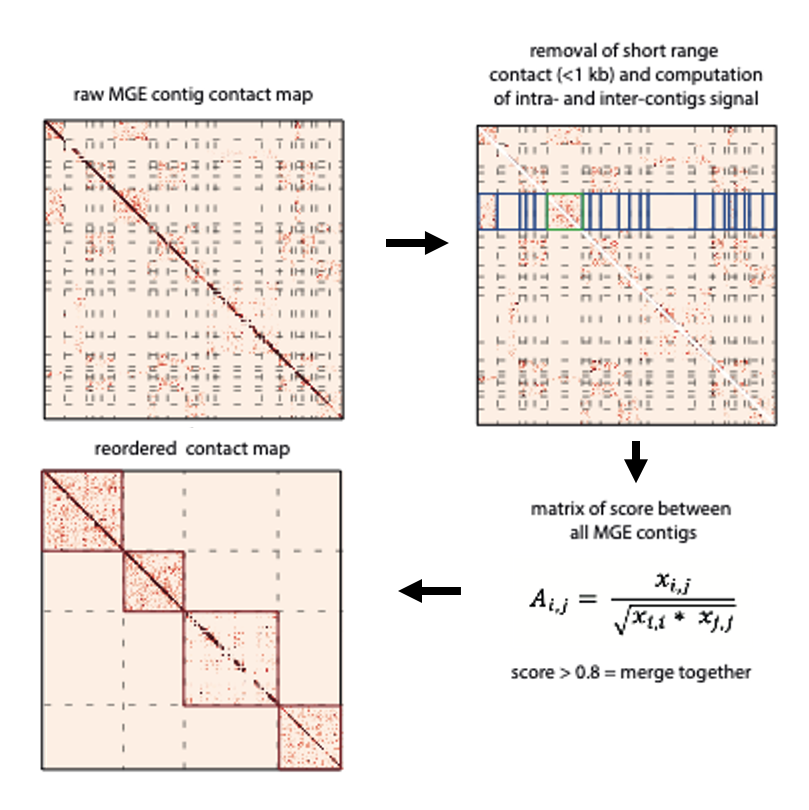
How it works
- Contacts. Between two MGE contigs: the contacts of the map, summed by
pair of contigs, whatever its bin size. Within a contig: only pairs whose
mates are more than 1 kb apart, which the map's contact statistics count
(metacooler's QC column
qc_intra_contig_long). - Scores. The score of contigs i and j is their contacts divided by the geometric mean of the contacts within each: Ai,j = xi,j / √(xi,i × xj,j).
- Merges. The two contigs with the highest score are merged if it is
above
--threshold-bin(0.8). The merged cluster takes the contacts of both, and its scores are computed again. This repeats until no score is above the threshold. Ties are broken in the order of the MGE contigs: longest first, then by name.
Each contig never merged is an MGE cluster of its own. Clusters are numbered in the order they are made, merged ones first, so a run gives the same MGE clusters, with the same names, on the map of the contigs and on the map of the clusters.
Running it
# A map that metator network, pipeline or validation wrote in binning: updated in place
metator mge binning/sample.metacool -a assembly.fa -m mges.txt -o binning
metator pipeline MAP --mges mges.txt runs it with --reassign as its step
mge, then metator host (see
Mobile genetic elements and their hosts).
| Input | What it is |
|---|---|
MAP |
A map that metator network stored its network in (the map that network, pipeline or validation wrote). It must hold the contact statistics of its contigs at 1001 bp, which hicstuff pipeline -M metacool and metacooler create pairs write with metacooler 0.4.0 or later (--qc-threshold 1001 with an earlier one) |
--assembly (-a) |
The FASTA file the map was made from, plain or gzipped |
--mges (-m) |
The MGE contigs, one name per line. Those missing from the map are left out, with a warning |
| Option | Default | Effect |
|---|---|---|
--threshold-bin (-s) |
0.8 | The score above which two contigs or clusters merge. Lower merges more |
--random (-r) |
off | Shuffle the contigs between the clusters, keeping the number of contigs of each: a random clustering to compare with. Stored as the round mge_random, written to fasta/mges_random/ |
--reassign |
off | Make each MGE cluster a genome of the map (see MGE genomes). Not with --random |
--outdir (-o) |
current directory | Where fasta/mges/ and the map go |
--inplace |
off | Update MAP itself rather than the map of the output directory |
A map that mge cannot use is refused before anything is written, with the
reason and how to fix it (see mge).
Outputs
| Output | What it holds |
|---|---|
fasta/mges/ |
Two FASTA files per MGE cluster (MetaTOR_MGE_00001...): <name>.fa, its contigs, and <name>.stitched.fa, one record with the contigs joined by 200 N. Longest contig first |
The round mge of the map |
One cluster per MGE cluster: its contigs, length, GC content, hits and clustering score (BinningScore) |
sample.metator_<date>.log |
The log, in the current directory (sample for sample.metacool) |
The clustering score of an MGE cluster is the lowest score at which its contigs merged (empty for a single contig). The stitched file holds one sequence, for the tools that check the quality of an MGE genome and expect one sequence per genome.
mge writes no summary table: the round mge holds it, and
metator dump writes it out. -F replaces the
fasta/mges/ of an earlier run.
In the contact map of the run
mge adds the MGE clusters to the
clustering rounds of the map, as the round
mge, and keeps the other rounds (core, overlapping, recursive_<k>,
final). The entry mge of the metator key of the map's metadata records
the run: version, command line, parameters, and the columns it read. The
genomes and contigs tables are left as they were, unless --reassign.
import metacooler

mc = metacooler.MetaCooler("binning/sample.metacool")
mc.clusters[mc.clusters["round"] == "mge"]  # one row per MGE cluster
mc.cluster_members("mge")                   # their contigs, in map order
mc.metadata["metator"]["mge"]               # the run
metator dumpwrites the roundmge(andmge_random) inclusters.txtandcluster_members.txt.- A second run replaces the round
mgeonly;--randomreplaces onlymge_random. - The map goes to the output directory, or
MAPis updated in place when it is already there or with--inplace(see Step by step). mgereads no cluster, so it runs on the map of the contigs (afternetwork) as well as on the map of the clusters. Butpartition,validationandpipelinedrop the roundsmgeandmge_random, with a warning: runmgeagain on their map (pipeline --mgesdoes it itself).
MGE genomes
With --reassign, each MGE cluster also becomes a genome of the map, named
after it, with its GC, Hit and BinningScore in the genomes table. Its
contigs leave the genomes that held them (MAGs or __unbinned__).
- The MAGs keep their other contigs and their validation values, which still
describe them with the contigs they lost. The log names each MAG that loses
contigs, and how many. The marker genes that
metator markersstored on their contigs, found in the MAGs with those contigs, give an estimate of their numbers without them: the log says once that the markers predate the new genomes, andmetator markersrun again finds them in the MAGs as they are (see Marker genes of the contigs). - A MAG made only of MGE contigs is no longer a genome, with a warning; the
round
finalkeeps it. - The column
mgeof the genomes table isTruefor MGE genomes andFalsefor MAGs (as text).
metator mge binning/sample.metacool -a assembly.fa -m mges.txt -o binning --reassign
metator dump binning/sample.metacool -o tables
The tables of metator dump follow the genomes: binning.txt,
contig_data_final.txt (Final_cluster) and cluster_summary.txt list the
MGE genomes next to the MAGs.
import metacooler

mc = metacooler.MetaCooler("binning/sample.metacool")
mc.genomes[mc.genomes["mge"] == "True"]  # the MGE genomes, with GC, Hit and BinningScore
A run that replaces the round mge (any run but --random) first undoes
the MGE genomes of the map: their contigs go back to their MAG or to
__unbinned__. So a second run with --reassign replaces the MGE genomes,
and a run without it restores the MAGs (a MAG that had lost all its contigs
comes back without values, with a warning: run validation again to measure
them).
The hosts
metator host finds the MAGs that host the MGE clusters: the MAGs their
contigs are in contact with. It reads the map that metator mge stored its
MGE clusters in, and stores the hosts there.
# The MGE clusters of the map of a run in binning, then their hosts: updated in place
metator mge binning/sample.metacool -a assembly.fa -m mges.txt -o binning
metator host binning/sample.metacool -o binning
- The MAGs are the genomes of the map: the final clusters of
validationorpipeline, or the bins of another binner, made genomes withmetacooler reassign.__unbinned__and the MGE genomes are not MAGs. - The MGE contigs count for their MGE cluster only. A MAG that holds some (a plasmid binned with its host) is taken without them.
- The signal of an MGE cluster with a MAG is the sum of the weights of
the network edges between their contigs, with the normalisation that
metator networkstored (empirical_hitby default, which corrects for coverage). The number of contigs of the MAG in contact is counted too. - A MAG is a host when its signal is at least
--min-sharepercent (10) of the signal of the MGE cluster with all MAGs, and at least--min-contigs(5) of its contigs are in contact with the MGE cluster. An MGE cluster can have one host, several or none.
| Option | Default | Effect |
|---|---|---|
--min-share (-s) |
10 | The share of the MGE cluster's signal with the MAGs, in percent, a host needs |
--min-contigs (-c) |
5 | The number of contigs of a MAG in contact with the MGE cluster a host needs |
--outdir (-o) |
current directory | Where tables/mge_hosts.txt, plots/mge_hosts.pdf, the log and the map go |
--inplace |
off | Update MAP itself rather than the map of the output directory |
Reading the hosts
- A small share of all contacts. The share counts only the contacts with
MAGs. An MGE cluster with few such contacts, such as a phage caught in free
particles, can get a host from a small part of its contacts: on a mock
community, a free 42 kb phage got a host from 1% of its contacts.
share_of_allintables/mge_hosts.txtis the share of all its contacts; when it is small, look at the contact map. - Several hosts are not always several species. A genome split into several clusters gives each a share of the signal: on the mock community, 12 of the 14 MGE clusters with several hosts had clusters of one genome as hosts. Related plasmids, assembled into shared contigs, also give a host for each genome that carries one. Check the taxonomy of the hosts, or their contacts with each other, before reading a broad host range.
- No noise filter.
metator hostdoes not estimate the noise of the library, nor keep a MAG as the only host when it has most of the signal. The rule of Bignaud et al. 2025, which adds both, is left to the analysis oftables/mge_hosts.txt.
What host writes
| Output | What it holds |
|---|---|
tables/mge_hosts.txt |
One row per MGE cluster and MAG in contact: their signal, the contigs of the MAG in contact, the share of the signal (share) and of all contacts (share_of_all), and whether the MAG is a host (see Hosts of the MGE clusters) |
plots/mge_hosts.pdf |
The distribution of the signal of the hosts (log scale) and of their share |
The round mge of the map |
The number of hosts of each MGE cluster, their names by decreasing share, and their shares (n_hosts, hosts, host_shares) |
| The genomes table of the map | The number of MGE clusters each MAG hosts, and their names (n_mges, mges) |
sample.metator_<date>.log |
The log, in the output directory |
The entry host of the metator key of the map's metadata records the run,
with the normalisation of the network it read and its digest
(network_digest).
import metacooler

mc = metacooler.MetaCooler("binning/sample.metacool")
mge = mc.clusters[mc.clusters["round"] == "mge"]
mge[["name", "n_hosts", "hosts", "host_shares"]]  # the hosts of each MGE cluster
mc.genomes[["name", "n_mges", "mges"]]              # the MGE clusters of each MAG
mc.metadata["metator"]["host"]                      # the run
metator dump writes the hosts of each MGE cluster in clusters.txt, and
the MGE clusters of each MAG in cluster_summary.txt.
A second host run replaces the hosts. A run that changes what they were
found from (the round mge, the genomes or the network) drops them, with a
warning: mge but --random, partition, validation, pipeline, and
network with another network. Run host again then; pipeline --mges
finds them again itself.
Marbouty et al., 2021, and Bignaud et al., 2025, study the phages of a community and their hosts (see Citing metaTOR).