Partition and validation
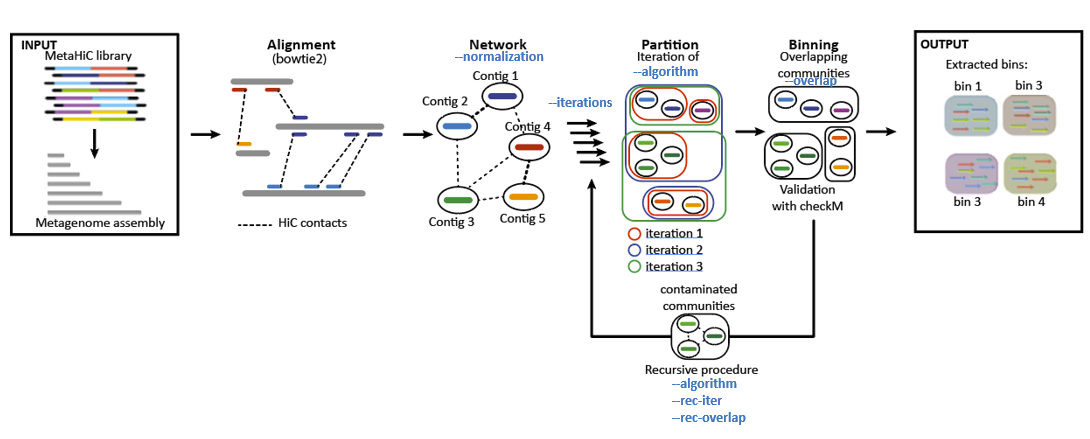
The second and third steps of metaTOR turn the network into clusters.
metator partition finds groups of contigs in the network stored in the map,
and metator validation checks them with miComplete and splits the
contaminated ones. metator pipeline runs both. Concepts
explains the principle; this page covers the parameters and the outputs.
Partition
# The map that metator network sample.metacool -o binning wrote, updated in place
metator partition binning/sample.metacool -t 16 -o binning
| Option | Default | Effect |
|---|---|---|
--algorithm (-A) |
louvain |
louvain or leiden. Louvain is faster, and gave better clusters in our benchmarks on gut and seawater samples |
--iterations (-i) |
100 | How many times the network is partitioned. More iterations give more, smaller core clusters; 100 found every cluster in our benchmarks |
--overlap (-O) |
80 | Two core clusters merge into one overlapping cluster when they fall together in at least this percentage of the iterations. Higher gives less contaminated but less complete clusters |
--res-param (-r) |
1.0 | The resolution of Leiden (1 is plain modularity, as in Louvain): higher gives more, smaller communities |
--prefix (-p) |
none | Names the overlapping clusters <prefix>_metator_… |
partition stores the core clusters (core_00001…) and the overlapping
clusters (metator_00001_00000…) in the map, as the rounds core and
overlapping. It writes no table and no FASTA file.
Validation
The validation checks the overlapping clusters of at least --size bp
(500 kb). It writes them as FASTA files in its temporary directory: give it
room for up to the size of the assembly, plus the decompressed copy of a
gzipped assembly. If no cluster reaches --size, the run stops with an
error. If the network was rebuilt since the partition, run partition again
first.
miComplete checks each cluster: it predicts genes with Prodigal and finds the single-copy marker genes of bacteria (105) and archaea (131) with HMMER (through pyrodigal and pyhmmer). Each cluster keeps the marker set that gives it the higher weighted completeness.
A cluster is contaminated when its weighted completeness is at least 33% and its contamination, (weighted redundancy − 1) / weighted completeness, is at least 5%. Each contaminated cluster is partitioned again, on the network of its own contigs:
| Option | Default | Effect |
|---|---|---|
--iterations (-i) of validation, --rec-iter (-j) of pipeline |
10 | How many times each contaminated cluster is partitioned |
--overlap (-O) of validation, --rec-overlap (-P) of pipeline |
90 | The overlap threshold of the recursive partition |
--algorithm, --res-param, --prefix |
As in the partition | |
--size (-s) |
500000 | The size, in bp, an overlapping cluster must reach to be checked, and a recursive cluster must exceed |
The parts larger than --size, the recursive clusters, are checked in
turn. They replace the cluster when the most complete of them keeps enough
of its completeness: more than 0.4 + (c − 0.4) / 1.6 for a cluster of
completeness c. Otherwise the cluster is kept whole. This repeats on the
recursive clusters that are still contaminated, for at most 9 steps. When a
cluster is replaced, the contigs of its smaller parts are left out of the
final clusters (ND).
Outputs
validation and pipeline write into the output directory:
fasta/mags_with-mges/: one FASTA file per final cluster, MGE contigs included;plots/: the plots of the final clusters (see Viewing the clusters);- the map of the clusters (see The contact map of the clusters),
and the log,
sample.metator_<date>.log.
Their other files go to the temporary directory of the run (-T), deleted
at the end unless -N: recursive_clusters/ (FASTA files, in step_<n>/),
cluster_summary.txt, contig_data_final.txt, binning.txt, and
miComplete's results (overlapping_micomplete_results.txt,
recursive_micomplete_step_<n>.txt). metator dump
writes the tables from the map at any time; File formats
describes them.
A final cluster is named after its overlapping and recursive clusters:
metator_00012_00003 is recursive cluster 3 of overlapping cluster 12, and
metator_00001_00000 an overlapping cluster kept whole.
Viewing the clusters
The log counts the final clusters in each quality class (HQ, MQ and LQ MAGs,
contaminated clusters and others: see
Cluster quality), and the run draws two
plots in plots/:
| Plot | Shows |
|---|---|
bins_distribution.pdf |
The completeness (red) and contamination (black) of each final cluster, by decreasing completeness, with dashed lines at the class thresholds. Contamination is capped at 105% |
bins_size_distribution.pdf |
The share of the contigs of the run in each quality class and in no cluster, with the number and size of the clusters of each class |
metacooler show draws the contacts between the final clusters (see
Other tools):
What comes next
- Curating MAGs with anvi'o: remove the contamination that is left, by hand.
- Other tools: the contact map of a cluster, and its scaffold, with metacooler, hicstuff and instaGRAAL.
- Clustering mobile genetic elements: the plasmids and phages, and their hosts.